If you want to give your car a sharp, premium face-lift, upgrading your registration plates is one of the quickest, most cost-effective ways to do it. Standard, flat-printed plastic plates do the job, but they can leave a modern car looking a bit basic.
However, if you have spent any time browsing automotive forums or social media, you have likely run into fierce debates regarding the legality of custom plates. With conflicting advice everywhere, it is easy to see why terms like “are 3d number plates legal” and “are 4d plates legal uk” rack up thousands of searches every month.
Let’s clear the air and look at exactly what the UK law says about 3D, 4D, and even 5D number plates, so you can upgrade your ride with 100% peace of mind.
Are 3D Number Plates Legal in the UK?
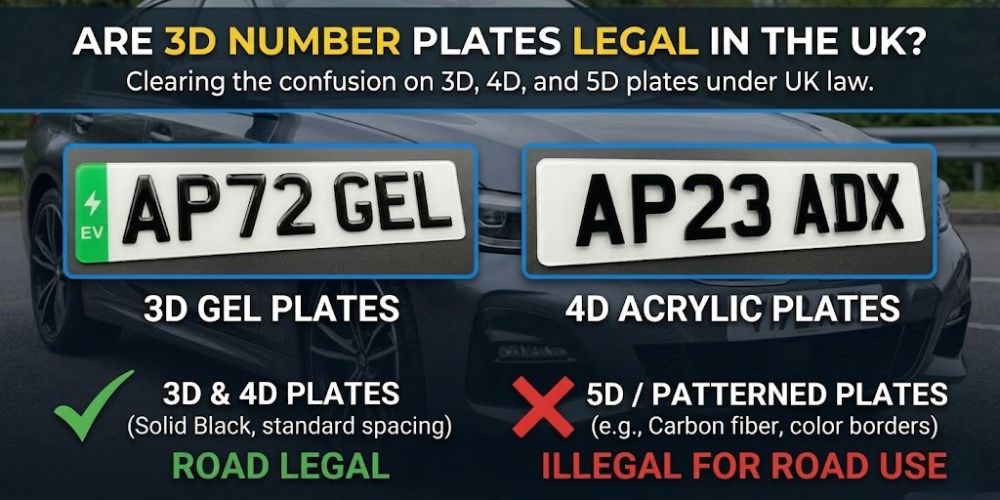
The short answer is yes, absolutely. Physical 3D number plates are fully road-legal in the UK, provided they are made by a registered supplier and meet standard formatting rules.
The origin of the confusion dates back to September 2021, when the government introduced the updated BSAU 145e manufacturing standard. This update explicitly banned two-tone or shaded effects on flat-printed plates—characters designed to trick the eye into seeing depth when they are actually completely flat. Because official announcements used the phrase “3D effects,” many drivers mistakenly assumed that physical, raised 3D gel plates were banned too.
The DVLA later clarified that physical, raised three-dimensional characters remain completely legal for road use. Because these raised characters are a solid, single shade of black, Automatic Number Plate Recognition (ANPR) cameras and traffic police can read them without any issues.
3D vs. 4D Number Plates: What Is the Difference?
To understand why some plates are legal and others walk a fine line, it helps to understand the physical difference between 3d and 4d number plates.
In the custom plate industry, these dimensions do not refer to physics or time travel; they simply describe the material and cutting styles used to create the characters.
3D Gel Plates (The Sleek, Domed Look)
When comparing 3d vs 4d number plates, 3D variants are characterized by their smooth, polyurethane gel resin construction. The characters are molded, giving them a distinct rounded, “domed” edge. They catch the light beautifully and offer a subtle, high-gloss premium look that isn’t too aggressive.
4D Acrylic Plates (The Bold, Laser-Cut Look)
4D plates take a sharper, more industrial approach. Instead of molded gel, the characters are precision laser-cut from solid sheets of acrylic. This creates perfectly straight, hard 90-degree edges that give a dramatic block effect. They stand out significantly further from the plate backing—typically available in 3mm or maximum-depth 5mm thicknesses—making a bold statement that looks great on modern bodywork.
4D Gel Plates
Many premium suppliers also offer a hybrid 4D Gel option. This features a solid laser-cut acrylic base topped with a smooth, glossy 3D gel dome, giving you maximum depth alongside a rounded, high-gloss finish.
Are 4D Plates Legal in the UK?
Just like 3D plates, 4D plates are 100% road-legal in the UK under the current BSAU 145e standard. However, because they are highly customizable, they are subject to strict scrutiny. To stay entirely within the law, your 4D plates must tick every single one of the following boxes:
- Solid Black Characters: The laser-cut acrylic must be a solid, non-reflective shade of black. You cannot use carbon fiber patterns, camouflage designs, or silver-edged lettering on public roads.
- The Charles Wright Font: Every character must use the official UK standard font. No italics, no script styling, and absolutely no altering of character shapes.
- Strict Legal Spacing: The gaps between your letters and numbers must perfectly match DVLA regulations. You cannot alter the spacing to make your registration spell out a name or word.
- Supplier Marking: The bottom of the plate must cleanly display the name, postcode, and BSAU 145e tracking code of the registered supplier who built them.
If a 4D plate misses even one of these criteria, it is classified as an illegal plate. This can land you an MOT failure, a £1,000 fine, and the DVLA can permanently revoke your registration mark.
What About 5D Plates?
As manufacturing technology moves forward, you will see a lot of interest surrounding 5D plates. But what are they, and are they legal?
In the current market, “5D” is a marketing term used to describe plates that combine multiple advanced styles. Usually, a 5D plate consists of a thick 4D acrylic base layered with a highly stylized top face, such as a carbon-fiber pattern, a colored neon under-layer, or a glitter gel finish.
The Legality Verdict on 5D Plates: Because the vast majority of 5D plates use patterned faces (like carbon fiber) or colored borders underneath the letters, they are NOT road-legal in the UK.
The law states characters must be a single, solid shade of black. If you install 5D plates featuring colored accents or patterns on your daily driver, you are highly likely to get pulled over by traffic police. These are strictly classified as “Show Plates” meant for track days, car meets, and private property display only.
How to Avoid a Fine: Buy from a Registered Supplier
The absolute easiest way to guarantee your custom plates are road-legal is to buy them from a certified member of the RNPS (Register of Number Plate Suppliers).
Legal, registered suppliers are legally required to verify your identity and your entitlement to the registration (using documents like your V5C logbook) before building your plates. They will also refuse to build non-compliant designs for road use.
If you buy cheap plates from an unregistered seller on social media who promises “no documents required,” you are almost certainly buying illegal plates made with substandard adhesives that will fail your next MOT.
Invest in your car the right way. Stick to solid black 3D gel or 4D acrylic from a trusted supplier, keep your paperwork straight, and enjoy a premium, legal upgrade that makes your car stand out for all the right reasons.
Conclusion: Style and Legality Can Go Hand in Hand
Upgrading your vehicle’s styling doesn’t have to mean constantly looking over your shoulder for traffic police or worrying about your next MOT. The urban legends surrounding a total ban on custom plates are simply false. As long as you stick to solid black characters, legal spacing, and standard fonts, 3D gel and 4D acrylic plates are 100% road-legal in the UK.
The secret to staying on the right side of the law comes down to choosing quality materials and a supplier that refuses to cut corners. By opting for a crisp, compliant set of plates from Aplates, you get to enjoy a premium, high-end look with total peace of mind. Operating from our dedicated units in Wiltshire, we use state-of-the-art laser cutting and commercial-grade, jet-wash-proof adhesives to build plates that look flawless and easily pass UK road regulations. Backed by a 3-year warranty and supplied with a complimentary premium fixing kit, our plates give your car that ultimate aesthetic upgrade effortlessly.